Casa Familiar presents
20th Annual Día de la Mujer Exhibition at The FRONT Arte & Cultura
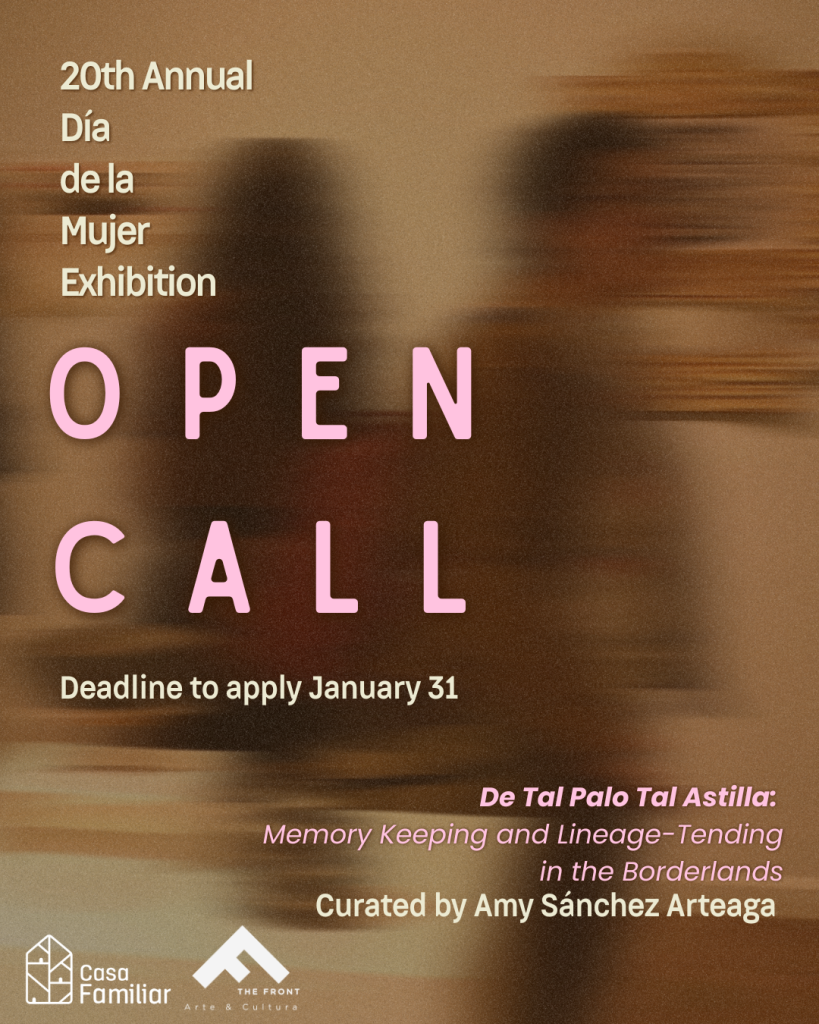
De Tal Palo, Tal Astilla: Memory keeping and lineage-tending in the borderlands
Curated by Amy Sánchez Arteaga
Exhibition Dates: March 6th – May 8th
Deadline for entry: January 31st, 2027
ELIGIBILITY: Open to womxn and non-binary artists. Submitted artwork must have been executed in the last 2 years and must be available for the duration of the exhibit. Only 20 artists will be selected through the open call. Selected artists will receive a $200 honorarium.
To apply, please read carefully the following information and send your application to:
Elizabeth Baca elizabethb@casafamiliar.org with CC to Alejandra Ruiz alejandrar@casafamiliar.org
Guidelines and Application Form Download Here
Participating artists are asked to submit their artwork in exploration and conversation with the following:
“You know, they straightened out the Mississippi River in places, to make room for houses and livable acreage. Occasionally the river floods these places. “Floods” is the word they use, but in fact it is not flooding; it is remembering. Remembering where it used to be. All water has a perfect memory and is forever trying to get back to where it was.”
–Toni Morrison, The Site of Memory
“The opposite of dispossession is not possession. It is not accumulation. It is unforgetting. It is mattering.”
— Angie Morrill, Eve Tuck, the Super Futures Haunt Qollective, Before Dispossession, or Surviving It
“I am chronicling a life in which details were kept from me and I did not have control of the narrative, or the world; therefore, attempting to tell it with linear storytelling will fail. I am a detective putting the story together.”
–Vanessa Angélica Villarreal, After the World-Breaking, World-Building
This 20th anniversary Día de la Mujer exhibition will gather works by mujeres and nonbinary artists that contemplate lineages of artistic production in our transborder region by inviting works that engage with memory, storytelling, forms of ancestral narration, recuperation, documentation, and speculation.
The exhibition calls for works that navigate time, history, memory, erasure, recuperation, personal and institutional archives, and counternarratives as strategies for (re)connecting and sustaining dialogue with lineage—as (self-)defined by artists in terms of biology, chosen family, friendship, relation to place and non-human living kin and/or through other forms of relation-making.
We celebrate the practice of remembering, rememory, unforgetting, unlearning, as acts of resistance in relation to our lineage(s). We honor the intersectional feminist teachers, matriarchs and ancestors that have created the intellectual, social, aesthetic, emotional and material conditions for our practices. We make for the future as we honor those that came before us whose propulsive teachings are alive in our practice.
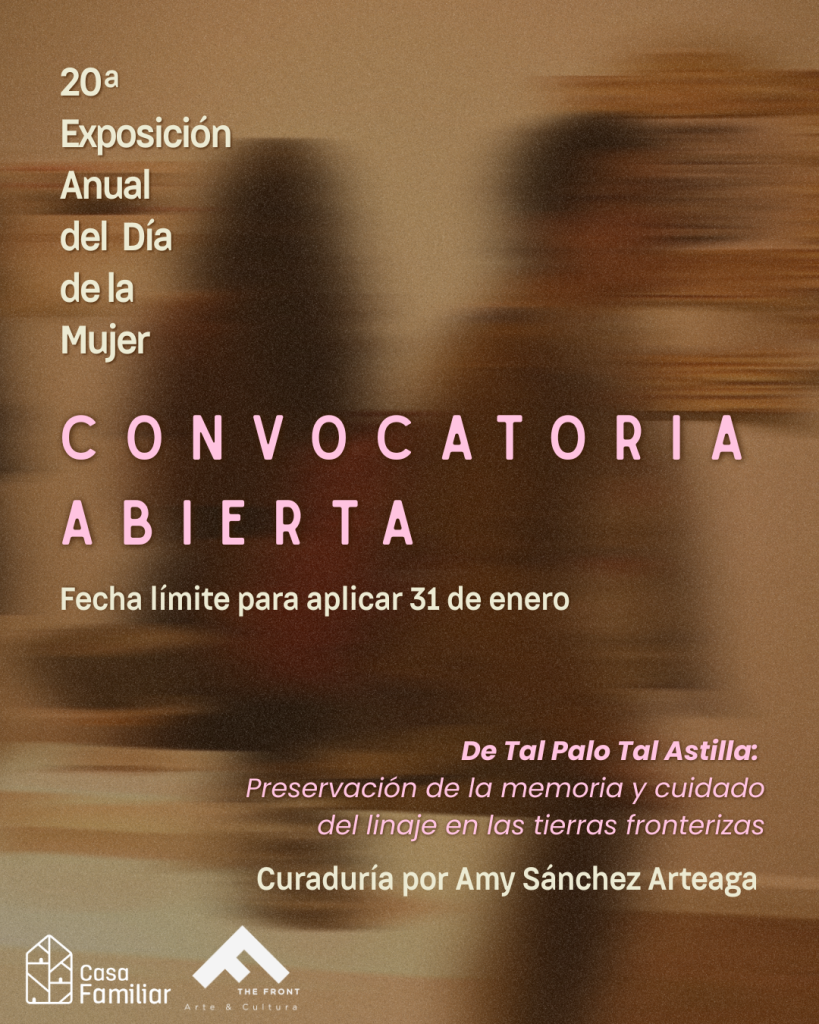
De Tal Palo, Tal Astilla: Preservación de la memoria y cuidado del linaje en las tierras fronterizas
Curaduría por Amy Sánchez Arteaga
Fechas de exhibición: Marzo 6 – Mayo 8
Deadline for entry: January 31st, 2027
ELEGIBILIDAD: Convocatoria abierta a artistas mujeres y personas no binarias. Las obras presentadas deben haber sido realizadas en los últimos 2 años y estar disponibles durante todo el periodo de la exposición. Se seleccionará a un total de 20 artistas a través de esta convocatoria. Las personas seleccionadas recibirán un honorario de $200.
Para postularse, lea atentamente la siguiente información y envíe su solicitud a:
Elizabeth Baca (elizabethb@casafamiliar.org), con copia (CC) a Alejandra Ruiz (alejandrar@casafamiliar.org).
Se solicita a los artistas participantes que presenten sus obras, las cuales deben surgir de una exploración y un diálogo en torno a lo siguiente:
“¿Sabes?, en algunos tramos, el río Misisipi fue rectificado para hacer espacio a viviendas y terrenos habitables. De vez en cuando, el río inunda estos lugares. “Inundación” es el término que emplean, pero, en realidad, no se trata de una inundació”n; es un acto de memoria. Es el río recordando dónde solía estar. Toda el agua posee una memoria perfecta y busca, de forma constante, regresar a su lugar de origen.”
—Toni Morrison, The Site of Memory
“Lo opuesto al despojo no es la posesión. Tampoco es la acumulación. Es el acto de no olvidar. Es el acto de reconocer lo que importa.”
—Angie Morrill, Eve Tuck y el colectivo Super Futures Haunt Qollective, Before Dispossession, or Surviving It
“Estoy documentando una vida en la que se me ocultaron detalles y en la que no tuve control sobre la narrativa ni sobre el mundo; por tanto, intentar relatarla mediante una estructura lineal resultará inútil. Soy como una detective que va reconstruyendo la historia.”
—Vanessa Angélica Villarreal, After the World-Breaking, World-Building
Esta exposición, con motivo del vigésimo aniversario del Día de la Mujer, reunirá obras de mujeres y artistas no binarios que reflexionan sobre los linajes de producción artística en nuestra región transfronteriza. La muestra invita a presentar trabajos que dialoguen con la memoria, la narrativa, las formas de relato ancestral, la recuperación, la documentación y la especulación.
La convocatoria busca obras que exploren el tiempo, la historia, la memoria, el borrado, la recuperación, los archivos personales e institucionales, y las contranarrativas como estrategias para (re)conectar y mantener un diálogo con el linaje —entendido, según la definición de cada artista, en términos biológicos, de familia elegida, amistad, relación con el territorio, vínculos con seres vivos no humanos u otras formas de establecer relaciones—.
Celebramos la práctica de recordar, de recuperar la memoria, de no olvidar y de desaprender, como actos de resistencia en relación con nuestros linajes. Honramos a las maestras feministas interseccionales, a las matriarcas y a las ancestras que han forjado las condiciones intelectuales, sociales, estéticas, emocionales y materiales que sustentan nuestras prácticas. Construimos hacia el futuro mientras honramos a quienes nos precedieron, cuyas enseñanzas, dotadas de una fuerza impulsora, permanecen vivas en nuestro quehacer.